


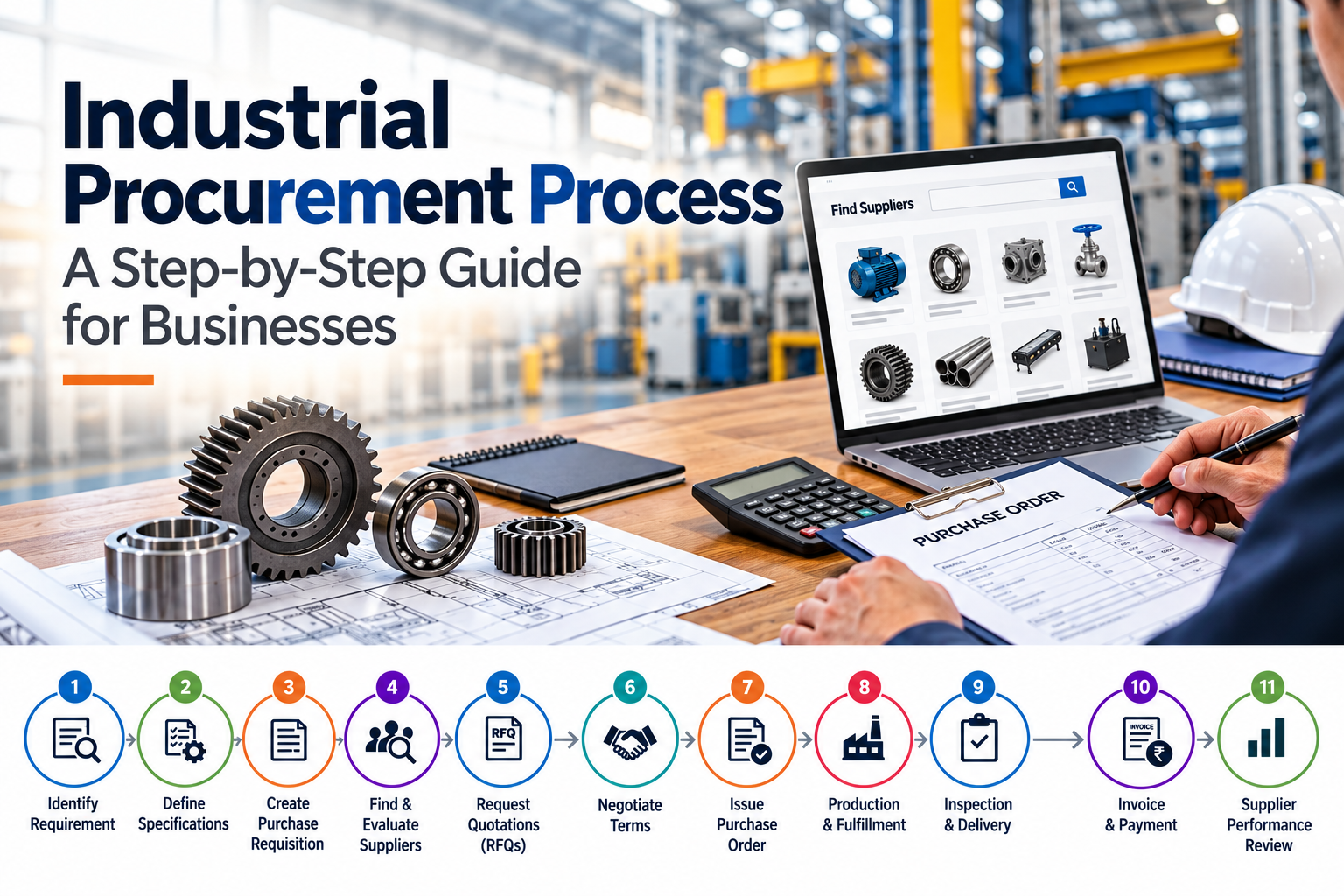
Industrial Procurement Process Explained – A Step-by-Step Guide for Businesses
Industrial procurement is much more than simply finding a supplier and placing an order. For manufacturers, engineering companies, contractors, distributors, and other B2B organizations, procurement directly affects cost, product quality, production continuity, delivery schedules, and overall supply-chain performance.
A structured procurement process helps businesses identify the right requirements, compare qualified suppliers, negotiate better commercial terms, control quality, and ensure that materials or equipment arrive when they are needed.
This guide explains the industrial procurement process step by step and highlights what businesses should consider at each stage.
What Is Industrial Procurement?
Industrial procurement is the systematic process businesses use to source and purchase raw materials, components, machinery, equipment, spare parts, tools, industrial products, and related services from external suppliers.
Unlike routine consumer purchasing, industrial procurement often involves:
- Technical specifications
- Large order quantities
- Customized products
- Multiple supplier comparisons
- Quality certifications
- Commercial negotiations
- Long lead times
- Logistics and transportation
- Inspection and testing
- Payment and credit terms
- After-sales support
For example, a manufacturing company may need to procure motors, bearings, gearboxes, hydraulic components, electrical equipment, steel products, conveyor components, or custom-engineered machinery. Each purchase may require a different sourcing and evaluation process.
Why Is a Structured Procurement Process Important?
A well-managed procurement process provides businesses with better control over purchasing decisions.
1. Cost Control
Comparing multiple suppliers and negotiating commercial terms can help businesses obtain competitive pricing without compromising required specifications.
2. Better Supplier Selection
Price should not be the only consideration. Supplier capability, quality, capacity, delivery performance, experience, and service should also be evaluated.
3. Consistent Quality
Clearly documented specifications and inspection procedures help ensure that purchased products meet technical and quality requirements.
4. Reduced Supply Risk
Businesses can identify potential supplier, production, logistics, and delivery risks before placing an order.
5. Improved Production Planning
Reliable procurement helps ensure that materials and components are available when production requires them.
6. Better Documentation
Purchase requisitions, quotations, purchase orders, inspection records, invoices, and delivery documents create a traceable procurement record.
Industrial Procurement Process: Step-by-Step
Step 1: Identify the Business Requirement
The procurement process begins when a business identifies a requirement. The requirement could come from:
- Production
- Maintenance
- Engineering
- Construction
- Projects
- Inventory planning
- Sales
- Operations
- New product development
At this stage, the purchasing team should understand exactly what is required, how much is required, and when it is required.
For example: a manufacturing plant requires 100 industrial bearings for an upcoming production schedule. Simply stating “we need bearings” is not enough. The procurement team needs the technical and commercial details required to identify suitable suppliers.
Step 2: Define Product Specifications
Once the requirement is identified, the business should prepare clear specifications. Depending on the product, specifications may include:
- Product name
- Part number
- Dimensions
- Material
- Grade
- Capacity
- Performance requirements
- Tolerance
- Voltage or power requirements
- Applicable standards
- Certification requirements
- Quantity
- Packaging requirements
- Delivery location
- Required delivery date
For engineered or technical products, drawings, datasheets, bills of materials (BOMs), technical specifications, or other documents may also be required.
Why does this matter? An unclear specification can result in suppliers quoting different products, making price comparisons inaccurate and increasing the risk of receiving an unsuitable product.
Step 3: Create a Purchase Requisition
The requirement is then formally documented through a purchase requisition or internal purchase request. A typical purchase requisition may include:
- Requested product or service
- Quantity
- Technical specifications
- Estimated budget
- Required delivery date
- Project or department
- Reason for purchase
- Suggested supplier, if applicable
The requisition is generally reviewed and approved according to the organization’s internal purchasing policies. This step provides an internal control before the organization commits to purchasing.
Step 4: Find and Shortlist Potential Suppliers
After the requirement is approved, procurement teams identify potential suppliers. Businesses may source suppliers through:
- Industrial marketplaces
- Manufacturer websites
- Supplier directories
- Industry exhibitions
- Trade associations
- Existing supplier networks
- Referrals
- Online B2B platforms
- Direct manufacturer outreach
For industrial purchases, supplier discovery should focus on capability and suitability, not simply the lowest price. A supplier shortlist may include manufacturers, authorized distributors, stockists, exporters, or specialized industrial vendors depending on the requirement.
For businesses looking for industrial suppliers, an online B2B marketplace such as E2E Marketplace can help connect buyers with companies offering engineering and industrial products.
Step 5: Verify and Evaluate Suppliers
Finding a supplier is only the beginning. The next step is supplier evaluation. Businesses should consider factors such as:
Product Capability
Can the supplier manufacture or supply the exact required product?
Quality
Does the supplier have appropriate quality-control systems and certifications?
Production Capacity
Can the supplier handle the required quantity and future demand?
Experience
Does the supplier have experience serving similar industries or applications?
Delivery Performance
Can the supplier meet the required lead time?
Financial and Commercial Reliability
Are the supplier’s payment terms and commercial conditions suitable?
Technical Support
Can the supplier provide technical assistance, documentation, installation support, or after-sales service when required?
Previous Performance
For existing suppliers, historical delivery and quality performance can be an important evaluation factor.
Supplier evaluation should therefore consider the overall value offered rather than focusing exclusively on unit price.
Step 6: Request Quotations From Suppliers
Once suitable suppliers have been shortlisted, procurement teams can issue an RFQ (Request for Quotation). An RFQ typically provides suppliers with the information needed to submit a commercial offer. It may include:
- Product specifications
- Quantity
- Required delivery date
- Delivery location
- Packaging requirements
- Quality requirements
- Documentation requirements
- Payment terms
- Commercial conditions
Suppliers then provide quotations containing information such as:
- Unit price
- Total price
- Taxes
- Lead time
- Freight or transportation charges
- Payment terms
- Warranty
- Validity of quotation
- Delivery terms
Using a standardized RFQ makes it easier to compare different suppliers on an equivalent basis.
Step 7: Compare Supplier Quotations
A common mistake in procurement is selecting the supplier offering the lowest unit price. Instead, businesses should calculate the total cost of procurement. For example:
| Evaluation Factor | Supplier A | Supplier B | Supplier C |
|---|---|---|---|
| Product Price | ₹1,00,000 | ₹96,000 | ₹1,05,000 |
| Transportation | ₹8,000 | ₹15,000 | ₹5,000 |
| Lead Time | 15 days | 30 days | 12 days |
| Warranty | 12 months | 6 months | 18 months |
| Quality Rating | High | Medium | High |
| Overall Evaluation | — | — | — |
The lowest quotation may not necessarily provide the lowest overall cost. Procurement teams should consider:
Depending on the product, factors such as downtime, warranty, maintenance, and rejection costs can have a significant impact on the actual procurement cost.
Step 8: Negotiate Commercial and Technical Terms
After evaluating quotations, the buyer may negotiate with shortlisted suppliers. Negotiation can cover:
- Product price
- Quantity discounts
- Payment terms
- Credit period
- Delivery schedule
- Freight
- Warranty
- Replacement policy
- Quality standards
- Inspection requirements
- Packaging
- After-sales service
- Contract terms
For large or recurring purchases, procurement teams should look beyond price and negotiate terms that reduce operational and supply-chain risk. A supplier offering a slightly higher price may still be the better choice if they provide substantially better quality, lead time, warranty, or service.
Step 9: Select the Supplier
After evaluation and negotiation, the procurement team selects the supplier that provides the best overall value. A supplier selection matrix can make this decision more objective. For example:
| Criteria | Suggested Weight |
|---|---|
| Price | 25% |
| Quality | 25% |
| Delivery | 20% |
| Technical Capability | 15% |
| Supplier Reliability | 10% |
| Service & Support | 5% |
The exact weighting should depend on the product and business requirements. For critical production components, quality and reliability may be more important than achieving the lowest purchase price.
Step 10: Issue the Purchase Order
Once the supplier has been selected, the business issues a Purchase Order (PO). The PO should clearly document the agreed transaction, including:
- Buyer and supplier details
- PO number
- Product description
- Part numbers
- Quantity
- Unit price
- Taxes
- Total value
- Delivery address
- Delivery date
- Payment terms
- Quality requirements
- Packaging requirements
- Warranty
- Applicable terms and conditions
The purchase order becomes an important reference document for subsequent delivery, receiving, invoice verification, and payment activities.
Step 11: Supplier Order Confirmation and Production
After receiving the PO, the supplier should confirm the order details. For manufactured or customized products, this may be followed by:
- Raw material procurement
- Production planning
- Manufacturing
- Assembly
- Quality testing
- Packaging
- Documentation
For critical or high-value orders, the buyer may also monitor production progress. This is particularly important when procurement involves long lead times or products that are manufactured specifically for the buyer.
Step 12: Quality Inspection and Verification
Quality control should not begin only after the goods arrive. Depending on the product, businesses may use different inspection stages:
Pre-Production Inspection
Confirms that materials, drawings, specifications, and production requirements are understood.
During-Production Inspection
Checks production progress and identifies potential quality problems before completion.
Pre-Shipment Inspection
Verifies finished products before they leave the supplier’s facility.
Incoming Inspection
The buyer checks the products after delivery.
Inspection may cover:
- Quantity
- Dimensions
- Material
- Product specifications
- Performance
- Packaging
- Documentation
- Visible defects
- Certification
Receiving and inspection are important because discrepancies such as short shipments or non-conforming products should be identified before invoices are fully processed.
Step 13: Delivery and Goods Receipt
Once the order is dispatched, the logistics process begins. The buyer should track:
- Dispatch date
- Transport details
- Expected delivery date
- Shipment documentation
- Quantity
- Delivery condition
- Actual receipt date
When the goods arrive, the receiving team verifies the shipment against the PO and delivery documents. Any discrepancy should be documented and communicated to the procurement team and supplier.
Step 14: Invoice Verification and Payment
After receiving the goods, the supplier submits an invoice. Businesses commonly compare three important records:
+
Goods Receipt
+
Supplier Invoice
This is commonly known as three-way matching. It helps identify discrepancies in quantities, pricing, and delivered goods before payment is processed. For example:
- PO: 500 units
- Goods received: 480 units
- Invoice: 500 units
The mismatch should be investigated before payment is released.
Step 15: Evaluate Supplier Performance
The procurement process does not end when the supplier gets paid. Businesses should regularly evaluate supplier performance using measurable KPIs. Common supplier KPIs include:
- On-time delivery rate
- Product rejection rate
- Quality performance
- Response time
- Lead-time accuracy
- Price competitiveness
- Warranty claims
- Order accuracy
- Documentation accuracy
- After-sales support
Tracking supplier performance helps businesses identify reliable suppliers and address recurring problems. It can also support future sourcing and negotiation decisions.
Industrial Procurement Process Flow
The complete industrial procurement process can be summarized as:
Common Challenges in Industrial Procurement
Even a well-defined procurement process can face challenges.
Incomplete technical requirements can lead to incorrect quotations and unsuitable products.
Solution: Prepare detailed specifications, drawings, part numbers, and technical documents before contacting suppliers.
The cheapest supplier may not provide the best overall value.
Solution: Evaluate quality, lead time, reliability, capacity, warranty, and service along with price.
Late delivery can affect production and project schedules.
Solution: Establish realistic delivery commitments and monitor order progress.
Non-conforming materials can result in rework, production downtime, or customer complaints.
Solution: Define quality requirements and inspection procedures before placing the order.
Missing quotations, POs, invoices, inspection reports, or delivery documents can make procurement difficult to track.
Solution: Maintain a centralized procurement record for every purchase.
Businesses may struggle to identify capable suppliers for specialized industrial products.
Solution: Use established B2B marketplaces, industry networks, exhibitions, directories, and supplier databases to expand sourcing options.
How Technology Is Changing Industrial Procurement
Traditional procurement often depends on emails, spreadsheets, phone calls, and manually maintained supplier information. Digital procurement platforms can simplify several stages of the process by helping businesses:
- Discover suppliers
- Publish requirements
- Compare supplier options
- Request quotations
- Organize supplier information
- Communicate with vendors
- Track purchasing activity
- Maintain procurement records
Modern procurement systems can also connect purchasing with ERP, inventory, finance, and supply-chain processes, creating greater visibility across the purchasing cycle.
For industrial buyers, digital B2B marketplaces can make supplier discovery more efficient by bringing buyers and industrial suppliers together in one environment.
Best Practices for Efficient Industrial Procurement
Businesses can improve their procurement process by following these best practices:
Define Requirements Clearly
Do not approach suppliers until the technical and commercial requirements are sufficiently clear.
Build a Qualified Supplier Network
Maintain relationships with multiple capable suppliers rather than depending entirely on one vendor.
Compare Total Cost
Evaluate the complete cost of purchasing, logistics, quality, maintenance, and service—not only the quoted unit price.
Standardize RFQs
Use consistent RFQ formats so supplier quotations can be compared fairly.
Verify Suppliers
Check capabilities, certifications, experience, capacity, references, and previous performance where appropriate.
Document Agreements
Ensure important commercial and technical terms are recorded in contracts, POs, and related documentation.
Monitor Quality
Use appropriate inspection and testing procedures for critical products.
Track Supplier KPIs
Measure delivery, quality, responsiveness, and reliability over time.
Use Digital Procurement Tools
Technology can reduce manual work and improve visibility across the procurement lifecycle.
Procurement vs Purchasing: What Is the Difference?
The terms procurement and purchasing are often used interchangeably, but they are not exactly the same.
Purchasing generally focuses on the transaction itself — ordering products or services, receiving them, and processing payment.
Procurement is broader. It includes activities such as:
- Requirement planning
- Supplier sourcing
- Supplier evaluation
- Negotiation
- Contracting
- Purchasing
- Receiving
- Supplier management
- Performance evaluation
In other words, purchasing is an important part of the broader procurement function.
How E2E Marketplace Can Support Industrial Sourcing
Finding the right supplier is one of the most important stages of industrial procurement.
E2E Marketplace is designed as an engineering products marketplace connecting businesses with industrial and engineering product suppliers. For buyers, an industrial marketplace can make it easier to discover suppliers across different product categories and initiate sourcing discussions.
Instead of relying solely on traditional supplier searches, businesses can use digital B2B platforms to expand their supplier network and identify potential sourcing opportunities.
Conclusion
A successful industrial procurement process is not simply about buying products at the lowest possible price. It is about obtaining the right product, from the right supplier, at the right quality, cost, and time.
From defining requirements and evaluating suppliers to issuing purchase orders, inspecting goods, processing invoices, and monitoring supplier performance, every stage contributes to procurement success.
Businesses that standardize these processes can improve purchasing visibility, reduce avoidable risks, strengthen supplier relationships, and build a more reliable supply chain.
As industrial sourcing continues to become more digital, B2B marketplaces and procurement platforms can also help businesses discover suppliers and make the sourcing process more efficient.
Looking to Source Engineering and Industrial Products?
E2E Marketplace provides a digital platform to explore industrial suppliers and procurement opportunities.